
A fiber optic cable can leave the factory in good condition and still arrive at the installation site with a damaged reel, loosened wraps, exposed cable ends, or a handling history nobody can explain. The risk often begins before the first meter is pulled: an uncontrolled drop, a drum stored on its side, a forklift tine pressing against the wound cable, or a reel rolled against its marked direction can create problems that are difficult to see until deployment.
Quick answer: receive each drum against its shipment records; inspect the cable, reel, protective wrap, end seals, and markings; move it upright with equipment rated for its weight; store it on both flanges on a firm, dry surface and chock it; preserve the manufacturer’s protection; and pay cable off under control without twisting it. The cable datasheet and the reel’s own markings govern the exact limits. A general article cannot replace the instructions for the cable and drum supplied for a particular project.
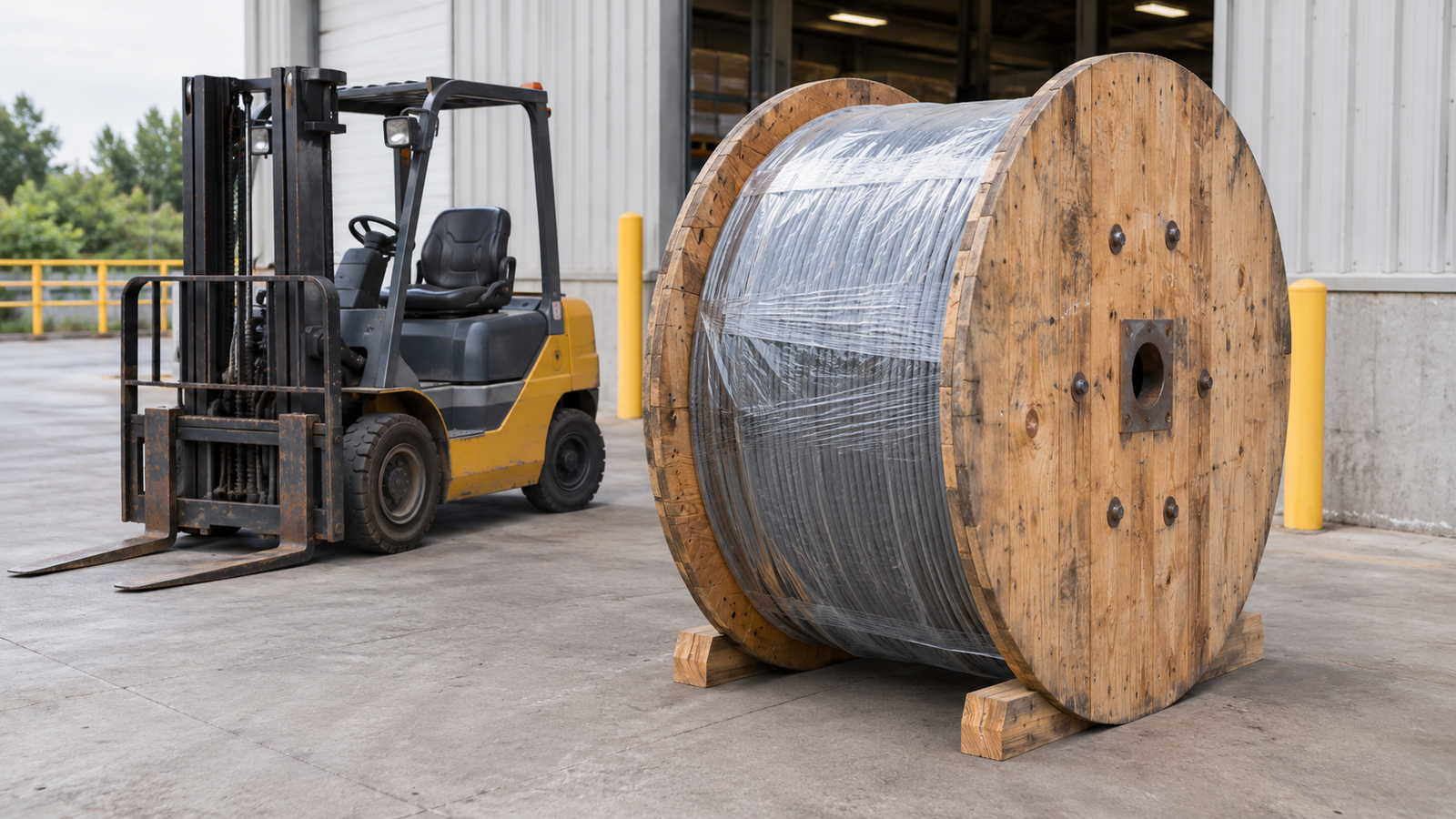
This field guide is for telecom project buyers, warehouse teams, contractors, and installers working with conventional fiber optic cable drums. It focuses on receiving, lifting, moving, storage, and payout preparation. It does not set universal temperature, stacking, rolling-distance, bend-radius, or pulling-tension limits; those depend on the product, drum design, local safety rules, and the manufacturer’s instructions.
At a glance: the safe-handling sequence
| Stage | Minimum control | Record or verify |
|---|---|---|
| Before delivery | Confirm unloading method, access, equipment, and storage area | Drum count, estimated weight, dimensions, delivery appointment |
| Receipt | Inspect the drum, cable layers, protection, labels, and end seals | Photos, reel number, cable type, length, visible damage |
| Movement | Keep the drum upright; use rated equipment and trained operators | Lift plan, equipment capacity, movement route |
| Storage | Rest on both flanges on a firm surface; prevent rolling and weather damage | Location, condition, dates, environmental limits |
| Payout | Align the drum with the route; control rotation and cable handling | Installation method, manufacturer limits, test plan |
Why drum handling matters for fiber optic cable
A cable drum is packaging, a transport frame, and a controlled payout device. Its flanges protect the outer wraps, its barrel supports the cable, and its shaft opening or designated lifting points allow the loaded reel to be moved. If any part is deformed, loose, wet, or unstable, the cable can shift or be pinched. The result may be visible jacket damage, displaced wraps, a bent flange, a cable tail pulled into the drum, or a defect that is not apparent until the cable is tested or installed.
Optical fiber is designed to operate within defined mechanical limits. Excess tension, a sharp bend, a kink, or twisting during payout can stress the cable structure and may affect optical performance. Damage can also be delayed: a project team may discover a fault during testing after the reel has moved through several hands. Good handling therefore protects not only the cable but also schedule, labor, traceability, and the ability to determine when damage occurred.
The actual sensitivity and correct handling method depend on construction. A large outdoor loose-tube cable, an ADSS cable, a small FTTH drop cable, and a pre-terminated assembly are not interchangeable in how they are packed or handled. Start with the exact product code and datasheet. OWIRE’s fiber optic cable range includes multiple constructions and installation uses; the product family alone does not establish a safe limit for a particular reel.
Plan the receiving area before the truck arrives
Do not wait for a loaded reel to reach the site before deciding where it will go. Confirm the unloading point, truck access, ground condition, forklift or lifting equipment, travel path, and storage position in advance. The route should be wide and firm enough for the planned equipment, with no abrupt step, soft shoulder, standing water, overhead obstruction, or congestion that forces a last-minute maneuver. If the final storage area is not ready, identify a controlled temporary location rather than leaving the reel exposed in a traffic lane.
Ask the supplier or carrier for the drum dimensions, gross weight, center-of-gravity information where available, and any designated lifting or rolling markings. Match these details to the truck’s unloading equipment and the site’s rated forklift, crane, reel trailer, or cable-drum jack. If the drum is unusually large or the equipment is not clearly suitable, get a competent lifting supervisor to determine the method. A cable drum should not be treated as a manually movable warehouse pallet simply because its wooden flanges look robust.
Brief the crew and isolate pedestrian traffic
Before unloading, agree who directs the vehicle, who operates lifting equipment, who checks the drum, and who keeps other workers clear. Use the site’s communication method and exclusion zone. No one should stand in the potential path of a rolling or falling drum, place hands between a flange and a wall, or try to catch a moving reel. Wear the personal protective equipment required by the site risk assessment, and follow local occupational-safety rules. A cable drum can weigh enough to cause severe crush injuries, so human strength is not a control measure.
Receiving inspection: what to check before acceptance
Compare the delivery with the purchase order, packing list, and approved cable specification. Confirm cable model and construction, fiber type and count where stated, reel identification, marked length, destination, quantity, and any packaging requirement. A mismatch should be recorded before paperwork is signed as complete. The receipt check complements a factory test document; it does not replace it. Similarly, a report that identifies the correct lot does not prove that the reel remained undamaged during transport.
Inspect both flanges and the barrel for cracks, splits, severe impact, distortion, loose bolts, missing or displaced battens, protruding nails or screws, and signs that the reel has been laid flat or dropped. Look at the outer cable layers for crushed sections, crossed wraps, loose or telescoped turns, abrasion, a cut jacket, contamination, or a cable end pulled loose. Check protective wrap and cable end caps for tears, water entry, or tampering. Do not remove intact factory protection merely to make a routine visual inspection easier.
Photograph the entire reel, each side label, the flange and barrel condition, any impact marks, the outer cable layers, and the end-seal area. Preserve the shipping documents and make the reel number visible in the record. If the wrap hides important damage, follow the supplier’s inspection procedure and replace the protection before storage. Avoid knives or other sharp tools near the jacket when opening packaging; FOA’s field guidance specifically warns against using sharp tools in a way that can damage the cable.
If something is wrong, mark the reel as held, prevent accidental issue to the installation crew, and notify the supplier and project owner with photographs and the reel number. Do not quietly straighten a flange, tighten hardware, rewrap an exposed cable, or pull a sample as if that settles the condition. Repairs or tests may be possible, but the responsible manufacturer or engineer should define inspection scope, acceptance evidence, and disposition. The decision is whether the exact reel is suitable for use, not whether the damage can be made less visible.
Unloading and lifting without loading the cable
Use the method specified for the reel and approved for the site’s equipment. For a forklift, keep the drum upright, approach so the forks support the designated flange areas or lifting points, and verify the forks are long enough and positioned to carry the load securely. The forklift’s capacity must account for the load center and the actual attachment, not just the nominal weight printed on the drum. Keep the mast and load stable, move slowly, and avoid sudden braking or turning that could shift the reel.
For crane or hoist movement, use a lifting bar or shaft through the drum bore with an appropriately rated, matched lifting arrangement and a spreader beam where required to prevent the lifting gear from squeezing or damaging the flanges. FOA guidance says slings or chokers should attach to a suitably sized pipe through the center hole and should never be attached around the spooled cable area. Follow the drum and lifting-equipment manufacturer’s rated points; do not improvise a sling around the cable barrel.
Never lift, support, or drag the load by the cable itself. Do not let the reel fall from a truck, fork, ramp, or dock edge. A drop can bend the flange or shock-load the cable even when the outside wrap looks intact. Use a tail lift, suitable forklift, crane, or engineered receiving platform. If a ramp is part of the approved plan, restrain and control the drum throughout the movement; the operator must not allow it to accelerate or run free.
Rolling direction is not the same as payout direction
Some flanges carry an arrow indicating the direction in which the drum should be rolled during transport. This marking should be followed when the reel is rolled, because moving it the wrong way can loosen cable layers. It does not automatically tell the crew which way cable should pay off during installation. Corning explicitly distinguishes the two: follow the flange arrow when rolling the reel on the ground; when paying cable off, the reel rotates in the opposite direction of that arrow.
This distinction prevents a common operational error. Read the actual marking and the supplied instructions instead of assuming that the arrow means the cable must unwind in that direction. A cable may be paid off over the top or from the bottom depending on the installation method and project preference. FOA notes that over-the-top payout is common, while bottom payout may be chosen for some blowing operations; the contractor and project team must decide based on the equipment, route, cable, and manufacturer’s guidance.
Storage: position, surface, weather, and protection
For conventional loaded cable drums, upright means the drum rests on both flange edges, with its axis horizontal and the flanges vertical. Do not store the reel lying on one flange unless the drum is specifically designed for that orientation and the supplier has approved it. Block or chock each reel so it cannot roll. Leave enough clearance to inspect labels and move lifting equipment without the forks contacting the cable on an adjacent drum.
Choose a firm, level, dry surface that can support the complete load. Keep the flanges from sinking into soft ground, and avoid standing water, flood-prone areas, unstable pallets, sharp rubble, and vehicle paths. If a pallet or timber bearer is used, confirm that it supports the reel without creating a point load or an unstable lean. Preserve any battens or protective components that the manufacturer expects to remain in place during storage.
Keep the drum’s protective wrap on until cable deployment is ready, unless the manufacturer’s inspection procedure requires a controlled opening. Where storage is outdoors, provide the protection specified for the cable and packaging. Corning recommends covered, ventilated storage when possible and warns that prolonged exposure to rain, snow, or sunlight can deteriorate wooden reels. Do not assume that an outdoor-rated cable means the wooden reel or the cable ends can be left uncovered indefinitely.
Long-term storage and partial drums
If installation is delayed, inspect the reel at intervals defined by the project or manufacturer. Check that chocks remain in place, the drum is upright, the protection is intact, labels are legible, the site has not flooded, and no equipment has struck the flanges. Follow any instructions about turning or repositioning reels; do not rotate them on an arbitrary schedule when the supplier has not specified one.
After a partial cut, secure the remaining cable end so it cannot loosen or be pulled into the wraps. Reseal the cable end with the closure method approved for that cable and restore the protective wrap if the reel will remain stored. Different guidance may specify tape or purpose-made end caps depending on cable construction and exposure. The important control is an end seal appropriate to the product that limits moisture or contamination entry without harming the jacket.
Setting up a reel for payout
Move the reel to a stable, level payout position and align its axis with the intended cable route and payout equipment. Use reel jacks, a shaft, a trailer, or another device rated for the drum. Secure the support against movement, verify the shaft and bearings are appropriate, and check that the reel can rotate smoothly without rubbing the frame. Use a braking or restraint method that gives the crew controlled payout without applying sudden drag to the cable.
The cable should roll off the reel rather than be spun over the end of a stationary drum in a way that adds a twist with every turn. The FOA recommends rolling cable off the spool to avoid introducing twist, and using figure-eight loops on the ground for longer pulls where needed to manage twist. Use a clean surface or suitable cable-management system for slack; protect the jacket from sharp edges, vehicle traffic, water, mud, and heavy objects.
Before the pull, agree on signals, stop conditions, communication roles, and the maximum tension and bend radius from the cable’s own data. Use the designated strength member or an approved pulling grip according to the cable design. Do not assume every cable may be pulled by its jacket or by the same attachment method. If the manufacturer’s limit is not available at the site, delay the pull until it is confirmed.
Cable-family considerations
A single operating rule cannot cover every fiber optic product. Outdoor loose-tube cables such as the GYTA, GYTS, GYTA53, GYFTY, and GYFTA families in the OWIRE catalog have different constructions and may include metallic or non-metallic strength elements, moisture barriers, armor, and inner or outer sheaths. Their reel weight, pulling method, and permitted bend and tension values must come from the exact construction data.
ADSS and figure-8 aerial cable are designed around different support arrangements. Their drum handling still needs stable upright storage and controlled payout, but installation tension, cable support, hardware, and route geometry have separate engineering requirements. A reel-handling guide should not be used to choose an aerial cable or to calculate a span. For those decisions, review the existing ADSS versus figure-8 cable comparison and the applicable product instructions.
FTTH drop cable and pre-terminated assemblies may arrive on smaller reels, coils, or packages with connectors that need additional protection. Do not let connectors drag, become contaminated, or bear the weight of the cable. Keep dust caps in place, preserve bend protection, and use the package orientation and handling instructions supplied for the assembly. A conventional drum-lifting procedure may not be appropriate for a carton or connectorized package.
Indoor distribution, breakout, simplex, and duplex cables can have different jacket and fire-performance requirements from outdoor cable. Do not store an indoor cable outdoors based only on the fact that it is fiber. Corning warns that indoor cables may not be protected from UV or water exposure. Confirm the cable’s storage environment, temperature range, and fire classification with the datasheet and project specification.
What to do when damage is suspected
Stop the movement or installation if there is a fresh impact, loose flange, sudden cable movement, crossed or displaced wraps, an exposed end, water ingress, or a cable that has been dragged, kinked, or sharply bent. Make the area safe first; then photograph the reel and the exact condition without disturbing the evidence. Record the date, location, operator, equipment involved, and whether the cable has already been paid off or installed.
Notify the project owner, supplier, and responsible engineer. Identify the reel number and share the purchase documents, shipment record, photographs, and any available factory test report. Ask what inspection and testing are appropriate. Depending on the event and the cable, the manufacturer may call for an external inspection, continuity check, optical test, sample testing, a controlled respool, repair assessment, or replacement. An apparently acceptable optical trace alone may not prove that no structural damage occurred.
A factory report and a site receipt check answer different questions. The report covers the measurements and samples described by its method; the receipt check records the state of the shipment at arrival. The site’s fiber optic cable test-report checklist explains how to review traceability, test method, acceptance limits, and reel-level records before shipment.
A practical receiving-to-installation checklist
| Check | Pass condition | Action if not met |
|---|---|---|
| Identity | Cable code, reel number, length, and shipment documents agree | Hold the reel and resolve the discrepancy |
| Reel condition | Flanges, barrel, bolts, and battens are sound and secure | Photograph, isolate, and ask for supplier disposition |
| Cable condition | Wraps are stable; jacket, ends, and seals show no suspected damage | Keep protected; request inspection or test direction |
| Unloading | Equipment, capacity, route, and trained operator are confirmed | Do not unload until a safe method is ready |
| Storage | Upright on both flanges, chocked, firm and dry, protected as specified | Move using approved equipment; correct the area |
| Payout | Manufacturer limits, end, direction, support, and pull roles are known | Pause setup until instructions are confirmed |
| Traceability | Photos, dates, movement, inspection, and disposition are recorded | Complete the record before releasing the reel |
Use this as a coordination aid, not as a substitute for the project’s formal lift plan or acceptance process. More handling steps or stricter checks may be required by local law, client standards, the reel weight, or the route conditions.
Frequently asked questions
Can a fiber optic cable drum be stored on its side?
A conventional loaded cable drum should normally rest upright on both flange edges, with its flanges vertical. Do not lay it on one flange unless the drum is specifically designed for that position and the manufacturer approves it. Follow the markings and written storage instructions supplied with the reel.
Which direction should the drum roll?
When rolling a reel on the ground, follow the arrow marked on the flange and any product-specific instructions. That arrow can indicate transport rolling direction; it is not necessarily the direction in which cable pays off. Corning notes that the reel rotates opposite the roll arrow during payout, so confirm the actual procedure before deployment.
Can I store fiber optic cable drums outdoors?
Only when the cable, reel, packaging, and site conditions permit it. Keep the drum upright, stable, off soft or wet ground, protected from impact and weather, and within the product’s storage temperature range. Some cables are not intended for outdoor storage, and wooden reels can deteriorate with prolonged exposure. Check the exact datasheet.
How should a large reel be lifted?
Use approved, rated mechanical equipment and the designated lifting arrangement. A forklift may support the reel at the flanges when the fork length, position, and capacity are suitable. For a crane, use the specified shaft or lifting bar through the arbor with compatible slings and a spreader where required. Never lift by the wound cable.
What should I do if a drum is dropped?
Secure the area and isolate the reel. Photograph and record the impact, inspect the drum and cable without disturbing evidence, then contact the supplier and project engineer for an inspection and test plan. Do not assume the cable is acceptable because the outer jacket looks intact or the drum can still rotate.
Does the flange arrow show the cable payout direction?
Not always. It may identify the direction to roll the drum during transportation or repositioning. The payout direction depends on the reel marking, cable design, route, equipment, and installation method. Read the manufacturer’s instructions rather than inferring payout direction from the arrow alone.
How should a partially used drum be protected?
Secure the loose cable layer and remaining cable end, reseal the end using the closure method specified for that cable, restore the supplied protective wrap, and return the reel to an upright, chocked storage location. Record the date and remaining length if the project requires it.
Final recommendation
Treat every cable drum as a controlled load and every reel movement as a documented handover. Plan the unloading area, inspect before acceptance, keep the drum upright, protect the reel and cable ends, and confirm the specific payout and mechanical limits before pulling. When the cable or packaging shows damage, pause and obtain a written disposition rather than transferring uncertainty to the installation crew.
For project supply, share the exact cable construction, fiber count, route environment, required length, packaging preference, destination, and any special handling requirements. Review OWIRE’s fiber optic cable products and send the requirements through the project inquiry page so the quotation and drum plan can be aligned with the installation.
Technical references
The handling practices in this guide are summarized from manufacturer and industry guidance. See Corning Application Engineering Note AEN165 for cable placement, reel storage, loading, and payout-direction notes; the FOA fiber optic installation reference for receiving, handling, storage, payout, and twisting; and the STL optical fiber cable drum handling procedure for upright movement, lifting, and transport controls. Always follow the specific cable and reel instructions supplied for the project.


