
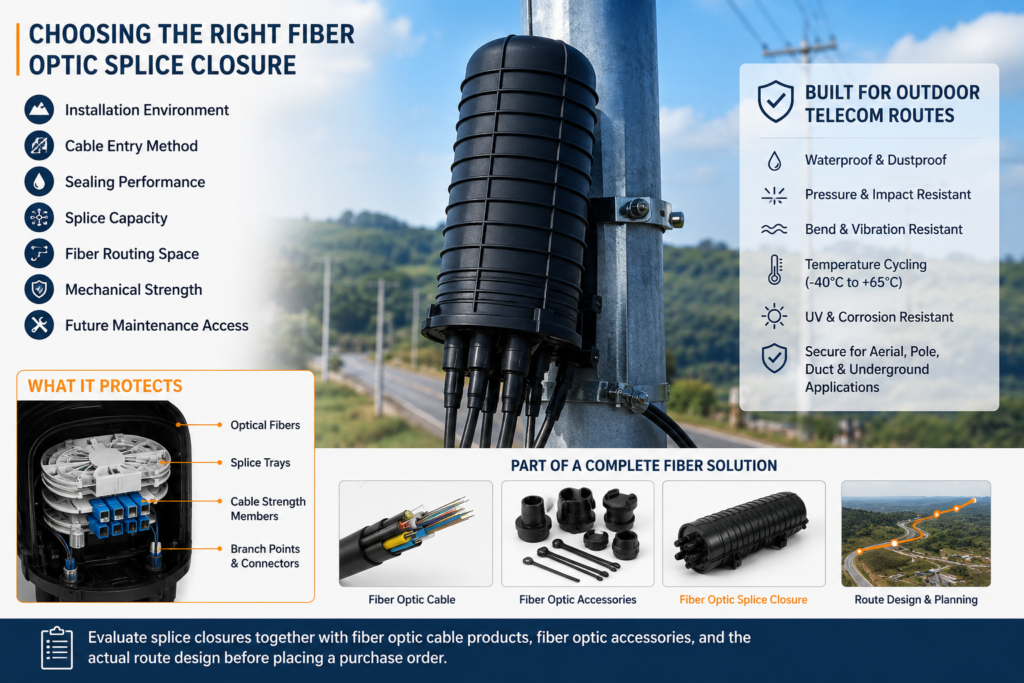
A fiber optic splice closure should be selected by installation environment, cable entry method, sealing performance, splice capacity, fiber routing space, mechanical strength, and future maintenance access. For outdoor telecom routes, the closure is not just a plastic box around splices. It protects optical fibers, splice trays, cable strength members, and branch points from water, dust, pressure, bending stress, temperature cycling, and field handling. Buyers planning an outside plant project should evaluate splice closures together with fiber optic cable products, fiber optic accessories, and the actual route design before placing a purchase order.
Quick Answer
Choose a fiber optic splice closure by matching the closure type to the installation method. A horizontal splice closure is suitable for aerial, pipeline manhole wall hanging, and direct burial installation. A vertical splice closure is suitable for aerial, pipeline manhole wall hanging, and suspension pole installation. The closure should support direct cable pass-through, branching, and fusion splicing; provide organized fiber routing; keep the fiber and cable bending curvature radius greater than 30 mm; use splice trays suitable for ribbon fiber or bundled fiber; and provide reliable sealing for the expected outdoor environment.
According to the FiberCableSupplier knowledge catalog, the listed fiber optical splice closure has IP68 protection, operating temperature from -40 degrees C to +60 degrees C, storage temperature from -40 degrees C to +70 degrees C, atmospheric pressure range of 70 kPa to 106 kPa, crush resistance of 2000 N/100 mm, axial tensile resistance of not less than 800 N, and material aging life of more than 20 years. The catalog also notes that the closure can withstand 10 bending cycles with 150 N bending tension and a bending angle of plus or minus 45 degrees.
Table of Contents
- What a Fiber Optic Splice Closure Does
- Why Splice Closure Selection Matters
- Horizontal vs Vertical Splice Closure
- Key Technical Requirements
- How to Choose by Installation Environment
- How to Evaluate Cable Entry and Branching
- Splice Tray and Fiber Routing Requirements
- Mechanical and Environmental Performance
- Procurement Checklist
- Installation and Maintenance Tips
- Common Mistakes to Avoid
- Factory Insights
- Frequently Asked Questions
- Conclusion
What a Fiber Optic Splice Closure Does
A fiber optic splice closure protects the physical connection point between optical fiber cables. In real outside plant work, this point may be a straight-through joint, a branch point, a distribution point, a repair point, or a route transition between different cable sections. The closure provides space for fusion splicing, fiber storage, cable fixation, sealing, and future access. Without the right closure, a well-selected outdoor cable can still fail at the joint.
The closure is especially important in projects that combine backbone cable, distribution cable, and access cable. For example, a rural broadband route may use outdoor loose tube cable on the main line, branch into an access route, and then connect to drop cable near the user side. Buyers comparing backbone and access cable choices can review FiberCableSupplier’s outdoor fiber optic cable selection guide and FTTH fiber optic cable guide to separate cable selection from closure selection.
A good closure does three jobs at the same time. First, it protects the splice area from water, dust, pressure, temperature change, and mechanical stress. Second, it keeps the optical fibers organized so bending radius and excess fiber storage are controlled. Third, it allows technicians to reopen, inspect, and maintain the circuit without turning a simple branch point into a messy field repair.
Why Splice Closure Selection Matters
Many procurement problems start because the RFQ only says “fiber optic splice closure” without describing the route. That is not enough information. A closure for aerial installation may need different mounting hardware and cable entry planning than a closure installed in a manhole or direct buried section. A closure used for a branch route must be planned differently from a straight-through joint. A closure used in an FTTH distribution network may need more frequent technician access than a buried backbone repair joint.
Closure choice also affects optical reliability. Fiber splices are sensitive to bending, pulling, compression, and poor storage. Even if the fusion splice loss is low at installation, poor routing inside the closure can create stress over time. The FiberCableSupplier catalog notes that fiber routing standards should ensure the bending curvature radius of optical fibers and cables is greater than 30 mm at any position. That one detail is a practical reminder: closure selection is not only about IP rating; it is also about fiber management.
For B2B buyers, the closure is a small part of the budget but a large part of long-term reliability. If water enters a closure, if a tray is overloaded, if the sealing kit is mismatched, or if the cable entry is poorly fixed, technicians may need to reopen the route repeatedly. That creates service risk for ISPs, labor risk for contractors, and warranty risk for distributors.
Horizontal vs Vertical Splice Closure
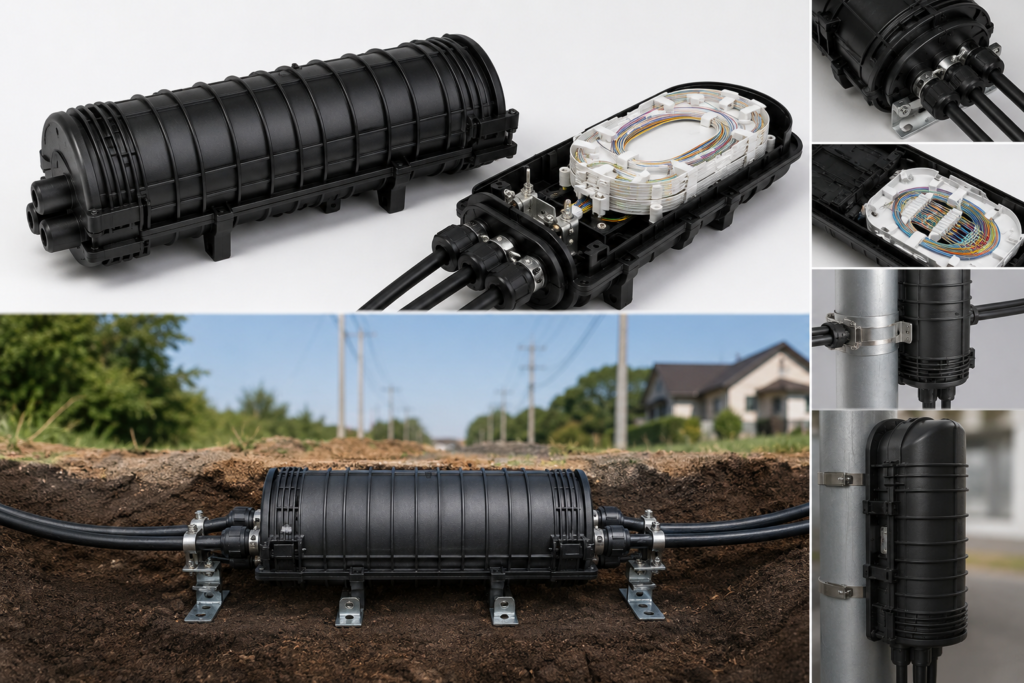
The first practical decision is closure format. The FiberCableSupplier catalog states that horizontal splice closures are suitable for aerial, pipeline manhole wall hanging, and direct burial installation. It also states that vertical splice closures are suitable for aerial, pipeline manhole wall hanging, and suspension pole installation.
This difference matters because closure shape affects mounting, cable entry direction, internal tray layout, and field access. A horizontal closure is often selected where the cable route continues in a line and the closure needs to lie along the cable path. A vertical dome-style closure is often selected where cables enter from one direction and the closure is mounted on a pole, wall, or support structure. The correct choice depends on the route layout, not only on habit or inventory availability.
| Closure Type | Catalog-Backed Installation Use | Best-Fit Project Situation |
|---|---|---|
| Horizontal splice closure | Aerial, pipeline manhole wall hanging, direct burial installation | Straight-through joints, duct routes, buried routes, and route sections where the closure follows the cable path. |
| Vertical splice closure | Aerial, pipeline manhole wall hanging, suspension pole installation | Pole-mounted networks, branch points, and access networks where technicians need organized vertical access. |
Neither type is automatically better. The better closure is the one that matches cable direction, mounting position, sealing method, tray access, and future maintenance. If the project includes aerial fiber hardware, the splice closure should also be coordinated with route hardware such as the ADSS fittings discussed in the ADSS fiber optic cable fittings guide.
Key Technical Requirements
A closure specification should be written around measurable requirements. The FiberCableSupplier catalog gives several useful parameters for optical cable splice closures, including IP68 protection, operating temperature, storage temperature, atmospheric pressure, sealing behavior, crush resistance, bending performance, tensile performance, standards references, and material aging life.
| Requirement | Catalog Information | Why It Matters |
|---|---|---|
| Protection grade | IP68 | Supports outdoor sealing requirements against water and dust exposure. |
| Operating temperature | -40 degrees C to +60 degrees C | Important for outdoor routes in cold and hot regions. |
| Storage temperature | -40 degrees C to +70 degrees C | Useful for logistics, storage, and project staging. |
| Atmospheric pressure | 70 kPa to 106 kPa | Relevant for different site elevations and environmental conditions. |
| Room temperature sealing | Internal inflation pressure 100 kPa for 24 hours without pressure drop | Indicates sealing behavior during pressure testing. |
| Temperature cycling | Good appearance and sealing after 20 cycles from -40 degrees C to +65 degrees C with internal pressure of 60 kPa plus or minus 5 kPa | Shows closure performance under repeated thermal stress. |
| Crush resistance | 2000 N/100 mm | Important for direct burial, manhole, and rough handling environments. |
| Axial tensile performance | Not less than 800 N | Helps protect cable entry points against pulling force. |
| Bending performance | 10 cycles at 150 N bending tension and plus or minus 45 degrees | Helps evaluate cable entry and field movement resistance. |
| Material aging life | More than 20 years | Important for long-life outside plant planning. |
The catalog also references YD/T814.1-2013, YD/T814.2-2005, ITU-T L.13, and UL94. Buyers should not treat these references as a substitute for project acceptance rules, but they are useful when discussing closure performance with engineering teams, contractors, and tender reviewers.
How to Choose by Installation Environment
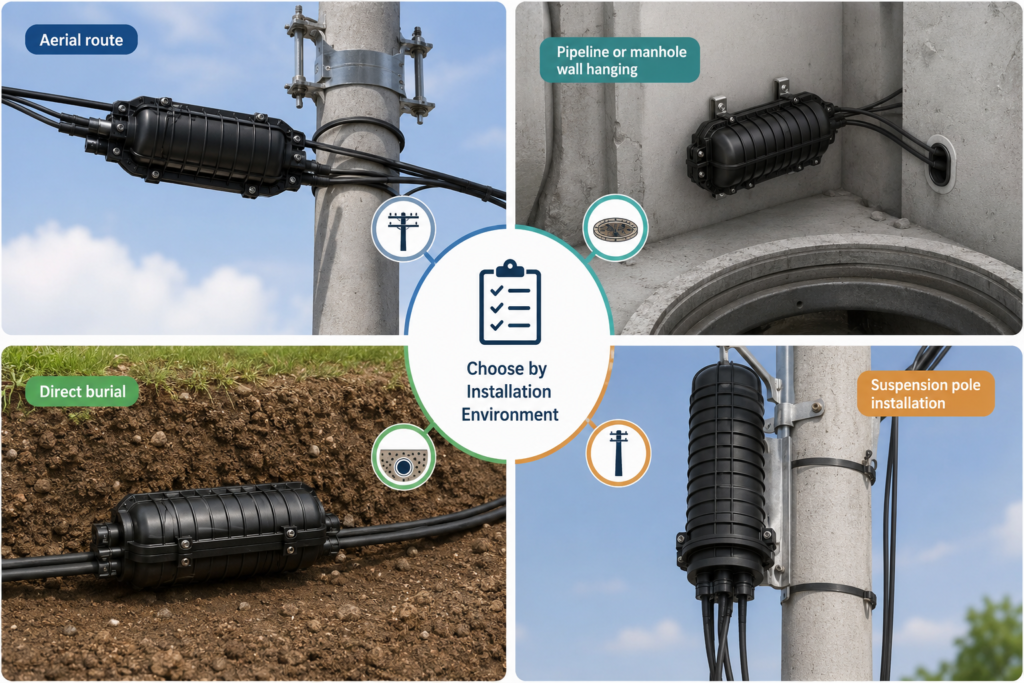
The installation environment should guide the closure body, mounting method, sealing structure, cable entry direction, and maintenance access. Aerial installations need secure mounting and wind-resistant cable management. Duct and manhole installations need sealing, corrosion resistance, and safe access in confined spaces. Direct burial installations need stronger protection from pressure, soil movement, and water exposure.
| Environment | Closure Selection Focus | Practical Buying Note |
|---|---|---|
| Aerial route | Mounting hardware, cable strain relief, sealing, and technician access | Coordinate closure placement with aerial cable hardware and pole layout. |
| Pipeline or manhole wall hanging | Sealing, wall mounting, corrosion resistance, and compact working space | Confirm cable entry direction and access space before ordering. |
| Direct burial | Crush resistance, IP rating, sealing, and long-term material durability | Horizontal closures are commonly considered where the closure follows the cable path. |
| Suspension pole installation | Vertical access, cable entry from below, mounting stability, and maintenance access | Vertical closure format may be suitable depending on the route layout. |
For outdoor telecom projects, closure selection should be made together with the cable route. The same network may include armored loose tube cable in buried sections, ADSS cable on aerial sections, and drop cable near subscribers. If the project team is still deciding between outdoor cable constructions, the GYTA vs GYXTW fiber optic cable comparison can help clarify how cable structure affects route design.
How to Evaluate Cable Entry and Branching
The FiberCableSupplier catalog states that the splice closure can provide direct, branching, and fusion functions for optical cables. This is a key buying point. A direct joint is simpler than a branch joint. A branch joint may need more cable ports, more internal routing discipline, better labeling, and enough tray capacity for current and future fibers. If the closure is used in a distribution route, branching flexibility can matter more than the lowest initial price.
Before buying, map every cable entering and leaving the closure. Count the main cable, branch cables, spare ports, and future expansion needs. Then confirm whether the closure supports the required cable diameter range, sealing accessories, and cable fixation method. If a cable is not properly fixed at the entry, pulling force can transfer into the splice tray area and create fiber stress.
Branching also affects documentation. Every fiber core should be identified clearly so future maintenance does not depend on guesswork. Fiber routes with ODBs, PLC splitters, and FTTH drops should be labeled in a way that technicians can follow. Buyers planning access networks can connect closure planning with FiberCableSupplier’s FTTH commercial broadband solutions and bow-type drop cable for duct where the route moves closer to end users.
Splice Tray and Fiber Routing Requirements
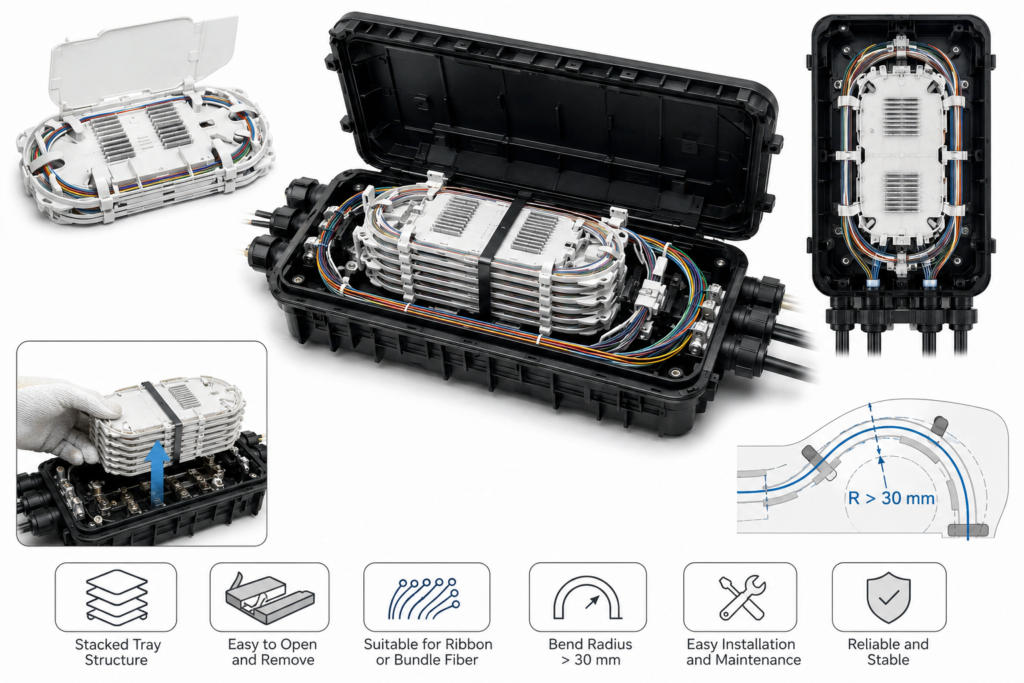
The splice tray is where many closure problems become visible. A closure may have a strong shell and good sealing, but if the tray layout is crowded, fibers are stored poorly, or the tray cannot be removed easily, maintenance becomes slow and risky. The FiberCableSupplier catalog notes that a fusion tray suitable for ribbon fiber or integrated bundle fiber can be selected and configured freely within the maximum capacity.
The catalog also describes a stacked fusion tray structure that is easy to open and can be removed for circuit installation and maintenance. This matters when technicians need to inspect one fiber group without disturbing every fiber in the closure. A neat tray system reduces accidental bending, makes troubleshooting easier, and helps preserve service quality when the network expands.
Fiber routing should keep the bending curvature radius greater than 30 mm at any position. This is not just a catalog detail; it is a field reliability requirement. Bend-sensitive routing can increase attenuation or create intermittent problems that are hard to diagnose. General optical fiber references such as ITU-T G.652 and ITU-T G.657 are useful for understanding fiber behavior, but the closure layout and project datasheet should control the installation details.
Mechanical and Environmental Performance
Outdoor closures must survive more than rain. They may face soil pressure, vehicle vibration near manholes, pole movement, wind movement, temperature cycling, cable pulling, and repeated technician access. That is why the mechanical specification deserves careful review. The catalog’s crush resistance of 2000 N/100 mm and axial tensile resistance of not less than 800 N are important when comparing closures for outside plant conditions.
Temperature cycling is also important. A closure may seal well on the workbench but fail after repeated expansion and contraction outdoors. The catalog states that the optical cable splice closure has good appearance and sealing after 20 temperature cycles from -40 degrees C to +65 degrees C with internal air pressure of 60 kPa plus or minus 5 kPa. Buyers in cold, hot, or high-variation environments should give this type of performance more weight than appearance alone.
For direct burial or harsh outdoor routes, long-term material behavior matters. The catalog lists material aging life of more than 20 years. This does not remove the need for correct installation, but it helps buyers evaluate whether the closure belongs in a long-life network rather than a temporary repair.
Procurement Checklist
- Confirm whether the closure will be installed aerial, in a duct, in a manhole, direct buried, wall-mounted, or pole-mounted.
- Choose horizontal or vertical format according to route layout and access method.
- Confirm cable diameter, number of cable entries, branch requirements, and spare ports.
- Check whether the closure supports direct, branching, and fusion functions.
- Confirm splice tray type, tray quantity, ribbon fiber or bundled fiber requirements, and future expansion.
- Verify fiber routing space and bending curvature radius greater than 30 mm.
- Check IP rating, operating temperature, storage temperature, pressure range, crush resistance, tensile resistance, and bending performance.
- Confirm sealing accessories, cable fixation, grounding requirements if applicable, and installation tools.
- Request matching accessories with the closure, not after the shipment arrives.
- Prepare labeling and documentation rules before installation begins.
For B2B procurement, the best RFQ should include the route type, cable type, fiber count, cable diameter, entry quantity, branch quantity, installation environment, expected maintenance access, and any local acceptance requirements. Buyers can send those details through the FiberCableSupplier contact page or review broader support options on the support page.
Installation and Maintenance Tips
First, confirm the cable route before opening the closure kit. Many field problems happen because the closure is selected for a drawing, but the actual route has an extra branch, a different cable direction, or a more difficult mounting position. If the field route changes, the closure model and accessories should be reviewed before installation.
Second, do not overload splice trays. Even if the closure shell has enough space, the tray must allow safe routing, clear identification, and maintenance access. Splices should not be forced into sharp bends or crowded spaces. Excess fiber should be stored in controlled loops rather than pushed into open space.
Third, treat sealing as a process, not a single part. The sealing performance depends on the closure body, cable entry sealing, gasket condition, tightening sequence, cable diameter match, and technician handling. A good closure can perform poorly if the cable entry is mismatched or the seal is contaminated during installation.
Fourth, document every fiber and branch. Labeling inside the closure saves time during fault repair and expansion. This is especially important in FTTH networks, campus networks, utility corridors, and ISP distribution routes where multiple technicians may work on the same closure over its service life.
Common Mistakes to Avoid
Mistake 1: Buying by Splice Count Only
Splice count is important, but it is not enough. A closure also needs the right cable entry, branch capacity, sealing kit, tray design, mounting method, and environmental performance. Two closures with the same splice count may perform very differently in aerial and direct burial conditions.
Mistake 2: Ignoring Installation Environment
A closure used in a manhole, on a pole, and in direct burial will face different mechanical and environmental risks. The closure format should be selected according to the route, not only warehouse availability.
Mistake 3: Poor Fiber Routing Inside the Closure
Poor routing can create bending stress even when the closure is sealed correctly. Keep routing organized, protect excess fiber, and maintain bending curvature radius greater than 30 mm as stated in the FiberCableSupplier catalog.
Mistake 4: Forgetting Future Branches
Many networks expand after the first installation. If the closure has no practical spare capacity, future work becomes slower and riskier. Plan branch requirements and spare ports before ordering.
Mistake 5: Treating Accessories as Separate Afterthoughts
Sealing accessories, mounting hardware, cable fixation parts, trays, labels, and grounding parts may decide whether the closure can be installed correctly. Order the complete closure system, not just the shell.
Factory Insights
From a factory quotation perspective, closure selection becomes much easier when the buyer provides the route environment and cable information. A clear inquiry should say whether the closure is for aerial, duct, manhole, wall hanging, pole mounting, or direct burial. It should also include cable outside diameter, cable count, branch count, splice capacity, tray requirement, sealing requirement, and whether future expansion is expected.
FiberCableSupplier’s catalog places fiber optical splice closure in the fiber optic cable accessories section alongside optical fiber cable distribution boxes, PLC optical splitters, optical cable fittings, optical modules, pre-terminated waterproof connectors, and patch cord products. This matters because a splice closure is usually not purchased alone. It belongs to a system that includes outdoor fiber cable, distribution hardware, access cable, and testing or maintenance plans.
If the project combines aerial cable, direct burial cable, and FTTH access, buyers should separate the bill of materials by route segment. A splice closure for a backbone joint, an ODB for distribution, a PLC splitter for passive optical splitting, and a drop cable for subscriber connection each solve a different problem. Treating them as one generic “fiber accessory” category creates mistakes in quotation and installation.
Frequently Asked Questions
What is a fiber optic splice closure?
A fiber optic splice closure is a protective enclosure used to house optical fiber splices, splice trays, cable entry points, branch points, and fiber storage in outdoor or indoor network routes.
What is the difference between a horizontal and vertical splice closure?
A horizontal splice closure is suitable for aerial, pipeline manhole wall hanging, and direct burial installation. A vertical splice closure is suitable for aerial, pipeline manhole wall hanging, and suspension pole installation.
What IP rating should an outdoor splice closure have?
The FiberCableSupplier catalog lists the fiber optical splice closure with IP68 protection grade, which is suitable for demanding outdoor sealing requirements when installed correctly.
What temperature range is listed for the splice closure?
The catalog lists operating temperature from -40 degrees C to +60 degrees C and storage temperature from -40 degrees C to +70 degrees C.
Why is fiber bending radius important inside a splice closure?
Bending radius affects optical performance and long-term reliability. The catalog states that fiber routing should ensure the bending curvature radius of optical fibers and cables is greater than 30 mm at any position.
Can a splice closure support branching?
Yes. The FiberCableSupplier catalog states that the splice closure can provide direct, branching, and fusion functions for optical cables.
What information should I provide when requesting a quotation?
Provide installation environment, cable diameter, cable entry count, branch count, splice capacity, tray requirement, mounting method, sealing requirement, and any future expansion needs.
Is a splice closure the same as an optical distribution box?
No. A splice closure protects cable splices and branch points, while an optical distribution box is typically used for fiber distribution, adapter mounting, and access network management. They may appear in the same project but serve different roles.
Conclusion
A fiber optic splice closure should be selected as part of the route design, not as a generic accessory. The right closure depends on installation environment, cable entry, branch function, splice tray design, fiber routing, sealing performance, mechanical strength, temperature range, and future maintenance needs. Horizontal closures, vertical closures, direct joints, branch closures, aerial routes, manhole routes, and direct burial routes each create different selection priorities.
For outdoor telecom networks, the safest buying approach is to match the closure with the cable route and the full bill of materials. Review the cable type, closure format, tray capacity, sealing accessories, mounting method, and expansion plan before ordering. If you are also selecting cables for the same project, start with FiberCableSupplier’s fiber optic cable products and accessories pages, then confirm the closure model with the engineering team.
Need help choosing the right fiber optic cable?
Our engineering team can recommend the best solution for your project. Contact us today for a free quotation.


