
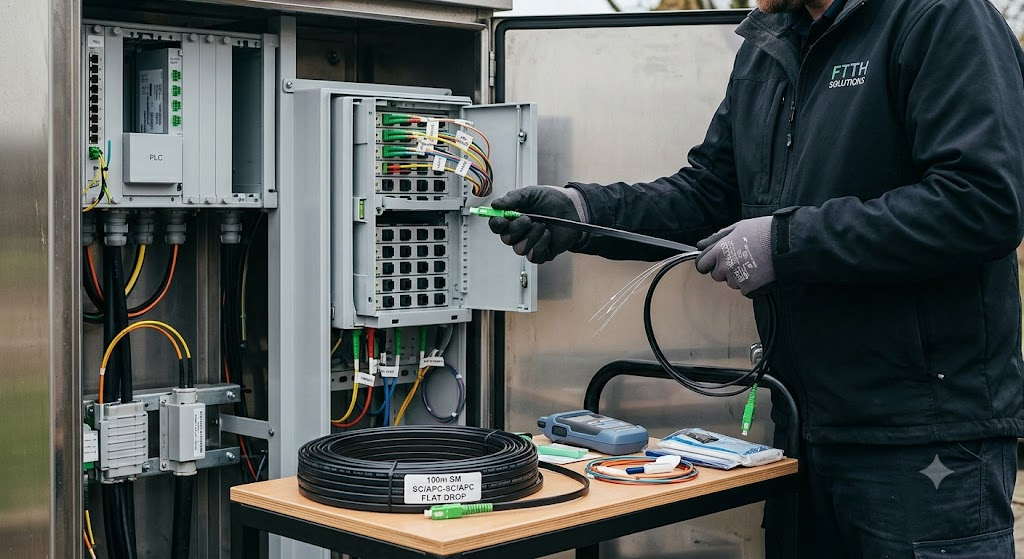
A pre-terminated drop cable patch cord is an FTTH cable assembly supplied with connectors already installed on one or both ends, so installers can connect a subscriber drop, access terminal, distribution box, or indoor outlet faster than with field termination. For broadband contractors, ISP procurement teams, and system integrators, the buying decision is not only about cable length or connector type. A good assembly must match the fiber type, connector polish, drop cable structure, installation route, optical budget, and service environment. This guide explains how to choose a pre-terminated drop cable patch cord for FTTH commercial broadband solutions, outdoor-to-indoor drops, and access network rollouts.
Quick Answer
Choose a pre-terminated drop cable patch cord by confirming the cable route first, then specifying fiber type, cable structure, connector type, connector polish, length, jacket material, tensile requirement, bend radius, insertion loss, return loss, and packaging. For most FTTH access projects, buyers compare indoor bow-type drop cable, duct drop cable, self-supporting bow-type drop cable, and connectorized assemblies with SC/UPC or SC/APC ends. The safest choice is the assembly that fits the installation route and preserves the optical budget with consistent connector polish across the ODB, splitter, terminal, and customer-side equipment.
The FiberCableSupplier knowledge catalogue includes pre-terminated drop cable patch cord under optical fiber patch cord and pigtail products. The same catalogue lists FTTH indoor bow-type optical fiber cable, bow-type drop cable for duct, self-supporting bow-type optical fiber drop cable, indoor simplex and duplex patch cord, and a pre-terminated waterproof connector. For patch cord products, the catalogue lists common connector types including FC, SC, LC, ST, MU, MT-RJ, E2000, and MPO/MTP, with PC, UPC, and APC end-face options, low insertion loss, high return loss, single-mode and multimode options, and operating temperature information.
Table of Contents
- What Is a Pre-Terminated Drop Cable Patch Cord?
- Why FTTH Buyers Use Pre-Terminated Assemblies
- Key Buying Criteria
- Technical Specification Table
- Comparison Table: Pre-Terminated vs Field-Terminated Drop Cable
- Application Scenarios
- Procurement and Installation Tips
- Frequently Asked Questions
What Is a Pre-Terminated Drop Cable Patch Cord?
A pre-terminated drop cable patch cord is a drop cable assembly with factory-prepared connectors. Instead of sending technicians to strip, terminate, polish, and test each connector in the field, the assembly arrives ready for connection. It may be used between an optical fiber cable distribution box and the subscriber premises, between an access terminal and a wall outlet, or between an outdoor drop point and indoor customer equipment. In many FTTH projects, the goal is to reduce field labor while keeping insertion loss and return loss predictable.
The product is different from a standard indoor patch cord because it is selected around the drop route. A standard patch cord may stay inside an equipment room, while a drop cable assembly may pass through ducts, wall entries, outdoor access boxes, risers, corridors, or customer premises. That means buyers must evaluate cable jacket, strength member, bend performance, connector protection, and route conditions together. If the assembly connects to a distribution point, it should also match the port layout explained in the optical fiber cable distribution box buying guide.
The FiberCableSupplier catalogue lists pre-terminated drop cable patch cord in the optical fiber patch cord and pigtail section. It also lists several related FTTH cable families, including bow-type drop cable for duct, self-supporting bow-type optical fiber drop cable, and FTTH indoor bow-type optical fiber cable. These related products show why the drop assembly should be treated as a complete system: the cable structure and connector interface must work together.
Why FTTH Buyers Use Pre-Terminated Assemblies
FTTH rollouts are repetitive. A contractor may need to connect hundreds or thousands of subscribers with similar drop routes, similar terminal boxes, and similar optical equipment. In that environment, field termination can become a bottleneck. It requires trained labor, stable working conditions, tools, connector consumables, cleaning supplies, and inspection discipline. Pre-terminated assemblies move much of that delicate work into a more controlled production process.
The main benefits are speed, consistency, and easier quality control. A factory-terminated assembly can be labeled, tested, packaged, and supplied in defined lengths. Installers can focus on routing, fixing, bend control, and final connection. For procurement teams, this can reduce variation between crews and sites. For network owners, it can reduce the risk of high-loss connectors caused by rushed field work.
Pre-terminated assemblies also support modular network design. A project can standardize several drop lengths and connector types, then deploy them across buildings, villas, apartments, retail sites, and small business connections. When used together with a PLC fiber optic splitter, a distribution box, and a splice closure, the assembly becomes part of a predictable passive optical network bill of materials.
The tradeoff is planning. A field-terminated cable can be cut to exact length on site, while a pre-terminated assembly must be ordered with enough accuracy to avoid excess slack or shortage. Buyers should review route drawings, wall entry points, riser paths, bend allowances, storage loops, and terminal box layouts before confirming lengths. A pre-terminated drop cable saves time only when the specification fits the real installation.
Key Buying Criteria
1. Cable Route and Installation Environment
Start with the route, not the connector. A drop cable used inside a building has different requirements from one pulled through duct or fixed along an outdoor wall. The FiberCableSupplier catalogue lists FTTH indoor bow-type optical fiber cable for indoor access, bow-type drop cable for duct, and self-supporting bow-type optical fiber drop cable for outdoor building access. A buyer should match the assembly to the environment before choosing connector polish or length.
Indoor routes usually prioritize flame behavior, bend management, neat routing, and compatibility with outlets. Duct routes need pullability and jacket suitability. Aerial or exterior building access routes may need additional messenger or self-supporting strength. For broader route planning, the outdoor fiber optic cable selection guide can help separate indoor, duct, aerial, and outdoor exposure requirements.
2. Fiber Type and Bend Performance
Most FTTH drop assemblies use single-mode fiber. The exact fiber category should match the network design and bend conditions. In tight indoor paths, bend-insensitive fiber can help protect performance when the cable passes through corners, small enclosures, outlets, or customer premises. International recommendations such as ITU-T G.657 are commonly referenced for bend-insensitive single-mode fiber, while ITU-T G.652 is widely referenced for standard single-mode optical fiber.
Do not assume all drop cables bend the same way. Cable structure, fiber category, jacket, strength members, and routing method all affect the final result. The catalogue describes bow-type drop cable structures with optical fiber in the center and parallel strength members on both sides. It also notes easy stripping and simplified installation for some FTTH bow-type designs. Those details are useful for installer efficiency, but the project still needs bend radius control and clean routing.
3. Connector Type
Connector type must match the distribution box, adapter, splitter output, terminal, or ONT interface. The FiberCableSupplier catalogue states that patch cord and pigtail products cover standard and customized connector types such as FC, SC, LC, ST, MU, MT-RJ, E2000, and MPO/MTP. In FTTH access networks, SC is very common, especially SC/UPC and SC/APC. LC may appear in some compact equipment, while MPO/MTP is more relevant to high-density or multi-fiber environments than ordinary single-subscriber drop links.
For a typical FTTH subscriber drop, buyers often standardize on SC because it is easy to handle, widely available, and compatible with many ODBs and passive components. If the drop assembly connects near an outdoor access point, review whether a pre-terminated waterproof connector is needed at the exposed side.
4. Connector Polish: UPC or APC
The catalogue lists PC, UPC, and APC end surface options for patch cord products. For modern FTTH and PON networks, UPC and APC are the most common choices. APC is often selected where lower reflection is important, especially in many PON and video-sensitive optical systems. UPC is common in many general digital optical links. The correct answer depends on the equipment interface and the network standard already used in the project.
The critical rule is consistency. Do not mate APC to UPC. A mismatch can create high loss, high reflection, and ferrule damage. Procurement documents should state the polish type clearly in the product name, label, package, test report, and installation checklist. This is one of the easiest errors to prevent and one of the most frustrating errors to troubleshoot after installation.
5. Optical Performance
Optical performance is the reason a pre-terminated assembly can be valuable. The catalogue states that patch cord and pigtail products have low insertion loss, high return loss, high reliability, and stability. It lists insertion loss as typical 0.20 dB and maximum 0.30 dB for single-mode and multimode connector categories. It also lists return loss values of PC ≥40 dB, UPC ≥50 dB, and APC ≥60 dB.
These values should be checked against the link budget. A PON link may already include feeder fiber, distribution fiber, splitters, adapters, splices, connectors, and the drop cable. If the splitter ratio is high or the route is long, small connector differences can matter. Buyers should define test wavelength, accepted loss limit, return loss requirement, sample inspection, and batch test documentation before mass shipment.
6. Cable Length and Slack Control
Length planning is where many pre-terminated projects succeed or fail. Too short, and the assembly cannot reach the terminal. Too long, and the installer must store excess cable in a small box, risking bend problems and poor appearance. The best approach is to standardize a few practical lengths based on route survey data, then allow proper slack for entry points, fixing clips, service loops, and terminal routing.
For multi-building or multi-floor projects, do not rely on a single average length. Separate apartment riser drops, villa drops, indoor office routes, and outdoor building access routes. Each route family may need its own length set and packaging label. This keeps installation faster while reducing waste.
Technical Specification Table
The table below converts catalogue-backed information and procurement practice into a practical checklist for pre-terminated drop cable patch cord buying.
| Item | Catalogue or Selection Basis | Buyer Recommendation |
|---|---|---|
| Product family | Pre-terminated Drop Cable Patch Cord listed under optical fiber patch cord and pigtail | Use for FTTH drop links where fast connectorized installation is required. |
| Related drop cable types | FTTH indoor bow-type cable, bow-type drop cable for duct, self-supporting bow-type optical fiber drop cable | Choose the cable structure according to the route and exposure. |
| Connector options | FC, SC, LC, ST, MU, MT-RJ, E2000, MPO/MTP and customized products listed for patch cords | Use SC/UPC or SC/APC for many FTTH projects unless the equipment requires another interface. |
| End surface | PC / UPC / APC | Keep polish consistent across ODB, splitter, adapter, terminal, and ONT. |
| Fiber category | Single-mode and multimode options listed for patch cord products | Most FTTH drops use single-mode fiber; confirm the project fiber category. |
| Insertion loss | Typical 0.20 dB, maximum 0.30 dB listed for connector categories | Set acceptance limits and request test documentation. |
| Return loss | PC ≥40 dB, UPC ≥50 dB, APC ≥60 dB listed | Select APC when the network design requires lower reflection. |
| Operating temperature | -25°C to +70°C listed for patch cord parameters | Confirm suitability for the installation environment and storage conditions. |
| Product standards listed | GR-326, IEC61754 series, YD/T1272 series, and ROHS references listed for patch cord products | Request documentation if the project requires formal compliance evidence. |
| Length | Project-specific | Standardize several lengths after route survey instead of guessing one length for all sites. |
Comparison Table: Pre-Terminated vs Field-Terminated Drop Cable
| Factor | Pre-Terminated Drop Cable Patch Cord | Field-Terminated Drop Cable |
|---|---|---|
| Installation speed | Faster final connection when length and connector type are correct | Slower because termination work is done on site |
| Quality consistency | More consistent when factory termination and testing are controlled | Depends heavily on technician skill and site conditions |
| Length flexibility | Requires accurate ordering and slack planning | Can be cut to exact site length |
| Tool requirement | Less termination tooling on site | Requires field termination tools and consumables |
| Best use | Repeatable FTTH drops, apartments, villas, campuses, commercial broadband rollouts | Highly variable routes or repair situations where exact length is unknown |
| Main risk | Wrong length, wrong polish, poor slack storage | High-loss field connector, contamination, inconsistent workmanship |
Neither option is automatically better in every project. Pre-terminated drop cable is excellent when the route is predictable and repeatable. Field termination remains useful when the site is irregular, the exact length is unknown, or the crew must adapt during repairs. Many network owners use both: pre-terminated assemblies for standard subscriber drops and field termination for exceptions.
Application Scenarios
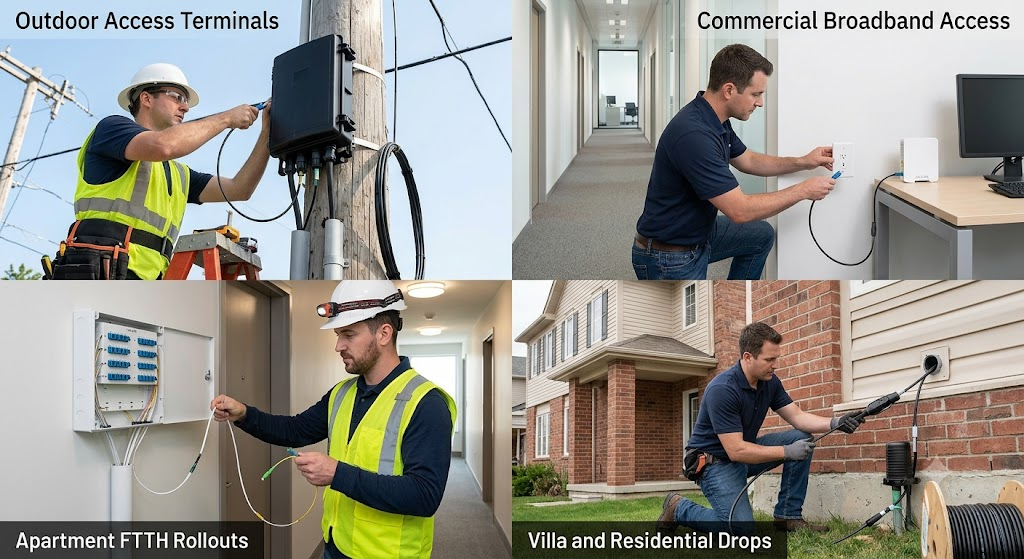
Apartment FTTH Rollouts
Apartment projects often have repeated floor layouts, similar riser paths, and predictable customer outlet positions. Pre-terminated drop cable patch cords can reduce installation time because each unit can use a planned length and connector type. The ODB or floor box should provide enough bend space and port identification to keep the installation neat.
Villa and Residential Drops
Villa drops may include outdoor-to-indoor routing, wall entry, and a longer customer-side path. The cable structure must fit the route, and the connector should be protected during pulling. If the outside connection is exposed, a waterproof connectorized interface may be needed. If the route is mostly indoor, a simpler SC/APC or SC/UPC connectorized drop may be sufficient.
Commercial Broadband Access
Small business and commercial broadband projects often need clean, repeatable installation with limited disruption. A pre-terminated drop assembly can reduce site time and avoid fiber termination work in public areas. For retail, office, and building access networks, the buyer should coordinate the assembly with the ODB, wall outlet, ONT location, and cable management method.
Outdoor Access Terminals
Procurement and Installation Tips
Build a Complete Ordering Specification
A useful ordering code should include cable type, fiber count, fiber type, connector type, connector polish, length, jacket, and any special packaging requirement. For example, an SC/APC single-mode FTTH bow-type drop assembly should not be ordered with a vague description like “green connector drop cable.” The clearer the order, the lower the risk of mixed polish, wrong length, or mismatched cable structure.
Protect Connectors During Pulling
Pre-terminated connectors are convenient, but they must be protected during installation. Do not drag the connector end across floors, ducts, wall openings, or dusty surfaces. Use protective caps and pulling protection when needed. After routing, inspect and clean the connector before mating. A factory-tested connector can still fail in the field if the ferrule is contaminated.
Plan Storage Loops Before Ordering
Slack is useful only when it can be stored safely. Before ordering lengths, check the space inside the ODB, wall box, terminal, or indoor outlet. Excess slack forced into a small enclosure can cause tight bends and service problems. If the route has uncertain length, consider several length options instead of one universal assembly.
Define Test Requirements
For B2B procurement, request test information that matches your acceptance process. Common checkpoints include insertion loss, return loss, connector polish, visual inspection, length, labeling, and packaging. If your project references GR-326, IEC61754 series, YD/T1272 series, or ROHS, ask for relevant documents before shipment. The FiberCableSupplier catalogue lists these references for patch cord products, but project acceptance should define the evidence required.
Common Mistakes to Avoid
| Mistake | Why It Matters | Better Practice |
|---|---|---|
| Ordering one length for every site | Creates excess slack in some places and shortage in others | Group routes into practical length families after survey. |
| Mixing APC and UPC | Can create high loss, reflection, and connector damage | Keep polish consistent and label packages clearly. |
| Ignoring cable route | Indoor, duct, and self-supporting routes need different cable structures | Select the drop cable type before confirming the assembly. |
| No connector protection during pulling | Dust and scratches can ruin a factory-tested connector | Use caps, pulling protection, inspection, and cleaning. |
| Skipping batch testing | Unverified assemblies can consume optical budget across many subscribers | Define loss limits and test documentation in the purchase order. |
| Forcing slack into a small box | Creates tight bends and poor serviceability | Plan storage loops and enclosure capacity before ordering. |
How to Build a Strong Purchase Specification
A strong purchase specification should read like a complete network component description, not a short cable label. Include the product name, cable structure, fiber type, fiber count, connector type, connector polish, length, jacket material, route environment, insertion loss limit, return loss requirement, operating temperature, packaging label, and required documentation. If the assembly connects to an ODB, splitter, or terminal box, include the matching interface and port requirement.
For example, a buyer may request a single-mode SC/APC pre-terminated FTTH bow-type drop cable patch cord in several standardized lengths for apartment access. Another project may request an SC/APC assembly with a self-supporting bow-type drop cable for outdoor building access. The correct specification depends on route, connector interface, service environment, and optical budget.
For a project-specific specification review and quote, send drawings, route photos, cable-path length, terminal type, connector interface, quantity, and installation environment through the FiberCableSupplier RFQ contact page. Compare the assembly with the fiber optic cable range, fiber optic accessories, and the documented cable manufacturing and testing workflow when building the project bill of materials.
Frequently Asked Questions
What is a pre-terminated drop cable patch cord?
It is an FTTH drop cable assembly supplied with connectors already installed, usually for faster connection between a distribution point, terminal, wall outlet, or subscriber-side device. It reduces field termination work and helps keep connector quality more consistent.
Is a pre-terminated drop cable better than field termination?
It is better when the route is predictable and the length can be planned. Field termination remains useful for irregular routes, repairs, or sites where the exact length is unknown. Many FTTH projects use both methods depending on the installation scenario.
Which connector is most common for FTTH drop cable assemblies?
SC connectors are very common in FTTH access networks, especially SC/UPC and SC/APC. The correct connector must match the ODB, splitter, adapter, terminal, and customer equipment used in the project.
Should I choose SC/APC or SC/UPC?
Choose the polish type required by the network equipment and existing passive components. APC is often selected where lower reflection is important, while UPC is common in many digital optical links. Never mate APC to UPC.
What insertion loss should buyers specify?
The FiberCableSupplier catalogue lists typical insertion loss of 0.20 dB and maximum insertion loss of 0.30 dB for patch cord connector categories. Buyers should define the accepted limit, test method, and batch documentation required for their project.
How do I choose the right length?
Survey the route, include service loops and terminal routing, then standardize several length families. Avoid using one average length for every site because it can create either shortage or excessive slack.
Can a pre-terminated drop cable be used outdoors?
It can be used outdoors only when the cable structure, jacket, connector protection, and terminal design are suitable for outdoor exposure. For exposed connector points, consider a waterproof connectorized interface and confirm sealing requirements.
What should be checked when receiving the shipment?
Check connector type, polish, cable length, fiber type, packaging label, connector caps, visible cable damage, and test documentation. Sample inspection before large-scale installation can prevent repeated faults across many subscriber drops.
Conclusion
A pre-terminated drop cable patch cord can make FTTH installation faster and more consistent, but only when the specification matches the route and the network interface. Buyers should start with the cable path, then confirm cable structure, fiber type, connector type, polish, length, optical performance, packaging, and documentation. The key is to treat the assembly as a complete FTTH component, not just a cable with connectors.
For a complete access network bill of materials, coordinate the pre-terminated drop cable patch cord with the ODB, splitter, splice closure, waterproof connector, and outdoor cable route. To discuss a project-specific assembly, request an FTTH drop cable quote with the installation environment, connector polish, route length, quantity, and equipment interface.


