
Selected topic rationale: Pre-terminated waterproof connector is a high-value supporting keyword for FTTH and outdoor fiber projects because it connects naturally with drop cable, distribution boxes, splice closures, and outdoor access networks. The topic is not yet covered in the local article archive, and it supports commercial searches from buyers comparing waterproof SC connector performance, cable compatibility, and installation reliability.
A pre-terminated waterproof connector is used when an optical link needs a fast, sealed, field-friendly connection without exposing the fiber interface to rain, dust, corrosion, or repeated outdoor handling. In FTTH drops, outdoor cabinets, pole-mounted closures, and building access points, the connector is often a small part of the bill of materials, but it can decide whether the link remains stable after months of temperature change, vibration, and moisture exposure. This guide explains how B2B buyers, network contractors, and procurement teams can evaluate an IP68 SC waterproof connector for FTTH commercial broadband solutions, outdoor access links, and last-mile fiber deployments.
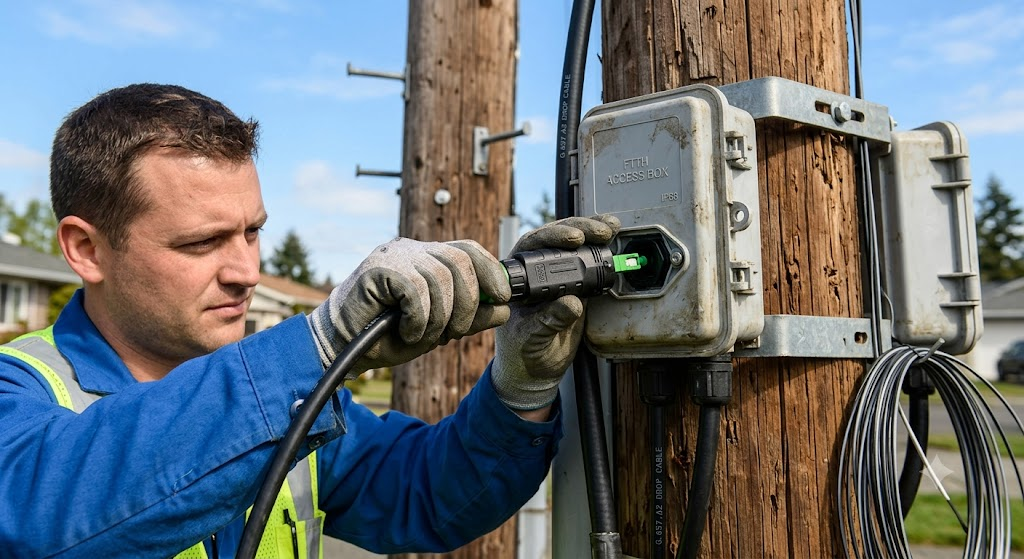
Quick Answer
Choose a pre-terminated waterproof connector by matching the connector type, end-face polish, cable diameter, sealing structure, optical performance, operating temperature, and installation environment. For many FTTH and outdoor access projects, a compact SC single-core waterproof connector with IP68 sealing, PC/UPC/APC end-face options, low insertion loss, high return loss, and compatibility with 3.0-5.0 mm single-core round cable or FTTH bow-type drop cable is a practical choice. The connector should also support fast field handling, a secure locking structure, and reliable sealing against water, dust, UV exposure, and corrosion.
The product information available in the FiberCableSupplier knowledge catalogue describes a small high-waterproof SC single-core connector with a built-in SC connector core, a special plastic shell resistant to high and low temperatures, acid and alkali corrosion, and ultraviolet exposure, plus an auxiliary waterproof rubber pad. Its sealing and waterproof performance can reach IP68 level, and its listed operating temperature range is -25°C to +70°C. That makes it relevant for outdoor FTTH drop cable, access terminals, and sealed connection points where a standard indoor connector would not be sufficient.
Table of Contents
- What Is a Pre-Terminated Waterproof Connector?
- Why Waterproof Connectors Matter in FTTH and Outdoor Fiber
- Key Selection Criteria for Buyers
- Technical Specifications to Check
- Comparison Table: Waterproof Connector vs Standard Connector
- Application Scenarios
- Installation and Procurement Tips
- Frequently Asked Questions
What Is a Pre-Terminated Waterproof Connector?
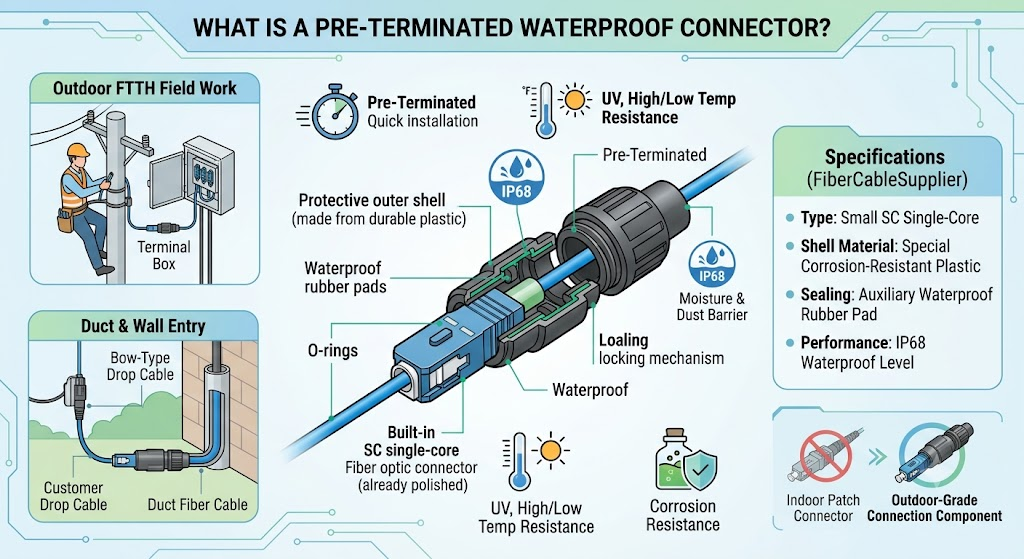
A pre-terminated waterproof connector is a sealed fiber optic connector assembly designed to protect the optical mating interface in outdoor or semi-outdoor environments. Instead of leaving a standard connector exposed to moisture, dust, or mechanical movement, the waterproof connector adds a protected housing, sealing components, and a locking method that keeps the connection stable after installation. In practical network design, it sits between the fiber cable and the access point, terminal box, cabinet, closure, or customer drop interface.
The term “pre-terminated” means the connector is prepared before or during the assembly process so the installer does not need to perform delicate fiber polishing at the final location. This is especially useful for field work where the installation team may be working on a pole, at a wall entry point, inside an outdoor terminal, or near an access cabinet. When the drop link is built around a bow-type drop cable for duct or another FTTH cable type, pre-termination can reduce site work and improve consistency.
In the FiberCableSupplier catalogue, the pre-terminated waterproof connector is described as a small SC single-core waterproof connector. It uses a built-in SC connector core and a shell made from special plastic that resists high and low temperatures, acid and alkali corrosion, and UV rays. The connector also uses an auxiliary waterproof rubber pad, and the sealing and waterproof performance can reach IP68 level. These points are important because they show that the product is designed as an outdoor-grade connection component, not merely an indoor patch connector placed inside a larger housing.
Why Waterproof Connectors Matter in FTTH and Outdoor Fiber
FTTH networks depend on a long chain of small passive components. The feeder cable, PLC fiber optic splitter, distribution box, splice closure, adapters, pigtails, drop cable, and customer connection must all preserve optical performance. A weak connector at the access point can introduce excess loss, reflection, intermittent faults, or moisture-related degradation. Because the connector is often the last removable interface before the subscriber side, it needs both optical quality and environmental protection.
Outdoor fiber networks face conditions that indoor patch panels usually avoid. Rainwater can enter poorly sealed interfaces. Dust and construction residue can contaminate ferrules. UV exposure can age unsuitable plastics. Temperature cycles can loosen weak mechanical structures. Cable movement caused by wind, installer handling, or enclosure maintenance can stress the connection. A waterproof connector addresses these risks by combining sealing, mechanical locking, guided insertion, and a connector core suitable for the optical link design.
For B2B buyers, the key point is not only whether a connector looks rugged. The connector should fit the cable structure, support the required polish type, meet the target optical budget, and suit the enclosure or outdoor terminal design. A waterproof connector used with an optical fiber cable distribution box must fit the port layout and installation method. A connector used near a fiber optic splice closure must maintain sealing after service access. A connector used in an outdoor drop route must match the drop cable dimensions and bend management plan.
Key Selection Criteria for Buyers
1. Connector Type
The first selection point is connector type. The catalogue-backed waterproof connector in this guide uses SC, one of the most common connector types in FTTH and access networks. SC is widely used because it supports simple push-pull mating, stable alignment, and broad compatibility with many FTTH terminal devices and passive components. If your project already uses SC adapters in distribution boxes, splitter modules, ONT access points, or pre-terminated drop assemblies, an SC waterproof connector helps maintain a consistent interface.
However, connector type must always match the rest of the system. Do not specify SC just because it is common. Check the existing adapter interface, the fiber terminal design, the splitter output, and the customer access equipment. If a project uses LC, FC, or another interface in specific areas, the connector plan should be reviewed as a system. For the strongest fit with FiberCableSupplier’s FTTH accessory cluster, SC waterproof connectors pair naturally with fiber optic cable accessories used in outdoor and last-mile networks.
2. End-Face Polish: PC, UPC, or APC
End-face polish affects return loss and network stability. The catalogue lists PC, UPC, and APC end-surface options for the waterproof connector. In general, UPC is common for many digital optical links, while APC is often preferred in PON and RF-sensitive optical systems because its angled polish can reduce back reflection. PC may be acceptable in some legacy or lower-reflection-sensitive applications, but buyers should follow the optical equipment and network design requirements.
The most important rule is consistency. Do not mate APC to UPC. A green APC connector and a blue UPC connector may look physically similar, but their ferrule geometry is different. Mixing them can cause poor contact, high loss, and damaged end faces. When building a procurement list, specify the end-face type in the part description, packaging label, drawing, and inspection checklist.
3. Cable Diameter and Cable Structure
A waterproof connector must seal around the cable. If the cable diameter is outside the connector’s supported range, the seal may be too loose or too compressed. The catalogue states that the connector is suitable for 3.0-5.0 mm single-core circular optical cables or FTTH bow-type drop optical cables. That makes it relevant for many access network drop applications, but the buyer should confirm the exact cable outside diameter, shape, jacket material, and strength member structure before ordering.
For FTTH projects, the connector may be used with indoor/outdoor drop cable, duct drop cable, self-supporting bow-type cable, or a single-core round access cable. FiberCableSupplier’s knowledge catalogue includes FTTH bow-type optical fiber cable, self-supporting bow-type drop cable, and other indoor/outdoor cable families. If you are still choosing the cable before choosing the connector, start with the full route design in the FTTH fiber optic cable guide and then verify connector compatibility.
4. Waterproof Rating and Sealing Design
The catalogue states that the waterproof connector’s sealing and waterproof performance can reach IP68 level. IP ratings are commonly used to describe enclosure protection against dust and water ingress, and IP68 indicates a high level of protection when the product is used according to its design and installation instructions. Buyers should still confirm how the supplier defines the test conditions, because immersion depth, duration, cable entry method, and assembly process can affect real-world performance.
Sealing is not only about a label. Look for the physical design: rubber sealing pads, compression around the cable jacket, protected mating areas, and a locking method that keeps the connector tight after installation. The FiberCableSupplier catalogue highlights an auxiliary waterproof rubber pad, a sealed design with waterproof, dustproof, and corrosion-resistant characteristics, and a spiral locking structure. Those features are directly relevant when the connector is used in outdoor telecom cabling solutions.
5. Optical Performance
Optical performance should be reviewed before mechanical convenience. The catalogue lists low insertion loss and high return loss as product characteristics. It also lists insertion loss of typical 0.20 dB and maximum 0.30 dB for both single-mode and multimode categories. Return loss is listed as PC ≥40 dB, UPC ≥50 dB, and APC ≥60 dB. These figures should be evaluated against the link budget, splitter ratio, fiber length, connector count, and active equipment sensitivity.
In PON networks, the optical budget can become tight when a link uses high split ratios, long drop routes, aging connectors, or extra patch points. If a project already includes a 1:32 or 1:64 splitter, a dirty or poor-quality connector can consume margin that should have been reserved for aging, repair, or future network changes. Good procurement practice is to specify the insertion loss target, inspection method, and accepted test report format before bulk delivery.
6. Temperature, UV, and Corrosion Resistance
The listed operating temperature range for the catalogue waterproof connector is -25°C to +70°C. That range is suitable for many access network environments, but buyers should compare it with the climate, enclosure location, and expected exposure. A connector inside a shaded cabinet will not experience the same heat as a connector exposed on an exterior wall. A connector in a coastal or industrial area may face more corrosion risk than one in a dry indoor riser.
The catalogue also describes the shell material as resistant to high and low temperatures, acid and alkali corrosion, and UV rays. This matters for outdoor installations because connector plastics, seals, and locking surfaces can age over time. For network owners, a connector that remains stable after repeated service access and seasonal temperature change can reduce fault tickets and protect the service reputation of the broadband operator.
Technical Specifications to Check
The table below summarizes the connector specifications available from the FiberCableSupplier knowledge catalogue and translates them into procurement checkpoints. Use it as a starting point for technical comparison, sample approval, and supplier communication.
| Specification | Catalogue Information | Buyer Checkpoint |
|---|---|---|
| Connector type | SC | Confirm adapter and terminal compatibility across the network. |
| End surface | PC / UPC / APC | Match the optical system and never mix APC with UPC. |
| Waterproof performance | Can reach IP68 level | Confirm test conditions and assembly method for the specific project. |
| Cable compatibility | 3.0-5.0 mm single-core circular optical cable or FTTH bow-type drop optical cable | Verify cable outside diameter, shape, jacket, and strength member. |
| Insertion loss | Typical 0.20 dB, maximum 0.30 dB | Check against link budget and test report requirements. |
| Return loss | PC ≥40 dB, UPC ≥50 dB, APC ≥60 dB | Select polish type according to network reflection requirements. |
| Operating temperature | -25°C to +70°C | Compare with climate, enclosure, and exposure conditions. |
| Sealing structure | Auxiliary waterproof rubber pad and sealed design | Inspect sealing parts during sample approval and installation training. |
| Locking structure | Spiral locking structure | Confirm easy handling and stable retention after field installation. |
| Product standards listed | GR-326, IEC61754 series, YD/T1272 series, and ROHS standard references | Ask for relevant documentation when the project requires formal compliance evidence. |
For broader network planning, these connector values should be reviewed together with fiber type and cable design. International recommendations such as ITU-T G.652 and ITU-T G.657 are often referenced when specifying single-mode fiber behavior and bend performance. The connector does not replace good cable routing, bend radius control, or clean end-face handling; it protects the interface only when the whole link is designed correctly.
Comparison Table: Waterproof Connector vs Standard Connector
A waterproof connector is not always needed. Indoor cabinets, clean equipment rooms, and protected patch panels may use standard patch cords and adapters. The value appears when the connection point is exposed to moisture, dust, repeated handling, or outdoor service conditions.
| Selection Factor | Pre-Terminated Waterproof Connector | Standard Indoor Connector |
|---|---|---|
| Best use | FTTH drops, outdoor terminals, wall entry points, pole-side access, sealed boxes | Indoor patch panels, equipment rooms, protected racks |
| Environmental protection | Designed for waterproof, dustproof, and corrosion-resistant connection | Requires a protected indoor or enclosed environment |
| Mechanical retention | Uses a protective shell and locking structure | Depends mainly on connector latch and adapter fit |
| Installation speed | Can support faster field connection when pre-terminated | Fast indoors, but not protected enough for exposed outdoor points |
| Procurement focus | Seal, cable diameter, locking method, IP level, optical loss | Connector type, polish, cable length, fiber type, jacket rating |
| Risk if misused | Wrong cable diameter or poor assembly may weaken sealing | Moisture and dust can quickly degrade outdoor performance |
If the project is entirely indoors, a standard patch cord may be more economical. If the connector will be exposed near a building entry, outdoor cabinet, drop cable transition, access terminal, or maintenance point, a waterproof connector is usually the more practical option. The goal is not to over-specify every connection, but to protect the connection points where the network is most likely to face weather and handling stress.
Application Scenarios
FTTH Drop Cable Connection
In FTTH networks, the drop cable links the distribution point to the subscriber location. This part of the network may pass through ducts, walls, building facades, aerial routes, or outdoor terminal boxes. A pre-terminated waterproof connector can reduce field splicing at the final connection point and help keep the service interface protected. When used with an appropriate drop cable, it supports faster installation and more consistent connection quality.
For drop cable selection, the connector should be checked against cable geometry. Bow-type drop cable may have a flat profile, while single-core round cable has a circular jacket. The catalogue states suitability for 3.0-5.0 mm single-core circular optical cables or FTTH bow-type drop optical cables. That gives buyers a defined compatibility window, but final approval should still include samples of the exact cable used in the project.
Outdoor Access Terminals and Distribution Boxes
Outdoor access terminals and distribution boxes are natural locations for waterproof connectors because technicians may need to connect, disconnect, inspect, or replace drop links. A connector that supports guided insertion and a secure locking method can make maintenance cleaner. In projects using ODBs, the connector plan should match port spacing, adapter orientation, bend control, and technician access. The ODB buying guide explains how box layout and installation environment influence accessory selection.
Outdoor Cabinet and Pole-Mounted Networks
Outdoor cabinets and pole-mounted networks need stable interfaces because the connection may be exposed to wind, vibration, dust, and service handling. A spiral locking structure and sealed housing help reduce the chance of accidental loosening. The connector should also be installed with proper strain relief so cable movement does not transfer excessive force to the optical interface.
Installation and Procurement Tips
Specify the Connector as a System Component
Do not buy waterproof connectors as isolated hardware. Specify them together with cable type, adapter type, terminal box, splitter output, and testing plan. A connector with strong optical numbers can still fail the project if it does not fit the cable seal, cabinet opening, or adapter interface. For larger projects, prepare a small system sample that includes the cable, connector, adapter, terminal box, and test method before approving mass procurement.
Confirm End-Face Cleanliness and Inspection
Waterproof housing does not remove the need for clean connector handling. A sealed connector can still carry dust into the mating interface if the ferrule is contaminated before installation. Require protective caps, clean packaging, and an inspection process. Technicians should clean and inspect connectors before final mating, especially after outdoor storage or repeated handling.
Check Cable Retention and Bend Management
The connector should seal around the cable and protect the optical interface, but the cable route still needs strain relief and bend control. Do not leave the connector carrying the full weight of a drop cable. Use clips, trays, guides, or box routing features to control the cable. For aerial or exposed routes, the cable system should be designed separately using the correct outdoor cable and fittings; the connector is one part of that system.
Ask for Clear Batch Documentation
For procurement, request clear product information for connector type, polish, cable compatibility, insertion loss, return loss, operating temperature, sealing design, and packaging. If the project specification references GR-326, IEC61754 series, YD/T1272 series, or ROHS, ask for relevant documentation before shipment. The catalogue lists these standard references for the product, but each project should decide what evidence is required for acceptance.
Common Mistakes to Avoid
| Mistake | Why It Causes Problems | Better Practice |
|---|---|---|
| Choosing only by IP rating | Sealing can fail if cable diameter or assembly method is wrong. | Check IP level, cable compatibility, seal structure, and installation process together. |
| Mixing UPC and APC | Different ferrule geometry can create high loss and damage. | Keep polish type consistent across the link. |
| Ignoring cable shape | A round-cable seal may not suit every flat drop cable design. | Validate the exact cable and connector combination with samples. |
| Skipping optical testing | Visual inspection cannot confirm insertion loss or return loss. | Define test limits and acceptance records before bulk installation. |
| Using indoor connectors outdoors | Moisture, dust, and UV exposure can degrade the connection. | Use waterproof connectors at exposed outdoor or semi-outdoor interfaces. |
| No strain relief | Cable movement can stress the connector and seal. | Route and secure the cable before final locking. |
How to Build a Purchase Specification
A practical purchase specification should be clear enough that sales, engineering, quality inspection, warehouse staff, and field teams all understand the same requirement. For a waterproof SC connector, include at least the connector type, end-face polish, fiber mode, cable diameter range, cable shape, expected waterproof level, insertion loss, return loss, operating temperature, packaging, test report requirement, and target application. If the connector is supplied as part of a pre-terminated cable assembly, also specify cable length, jacket material, fiber type, color, labeling, and tolerance.
For example, a buyer might specify an SC/APC pre-terminated waterproof connector for FTTH bow-type drop cable, with IP68-level sealing, compatibility with the selected drop cable, low insertion loss, high return loss, and operating temperature suitable for outdoor access use. The buyer should then confirm the exact product drawing and sample performance before placing a large-volume order. When the project includes other passive components, coordinate the connector specification with fiber optic cable, accessories, splitters, and terminal boxes as a complete network package.
When to Contact the Supplier
Contact the supplier early if the project has unusual cable dimensions, special outdoor exposure, a non-standard connector interface, tight optical budget, or a custom terminal box. Waterproof connectors are small, but they interact with many parts of the network. Early review can prevent mismatch between cable, connector, box, and installation method. For project-specific selection, send drawings, cable data, environment details, and required polish type through the FiberCableSupplier contact page.
Frequently Asked Questions
What is a pre-terminated waterproof connector?
A pre-terminated waterproof connector is a sealed fiber optic connector assembly prepared for field connection before final installation. It protects the optical interface from water, dust, corrosion, and outdoor handling while reducing the need for field polishing or complex connector preparation at the site.
Where is an IP68 SC waterproof connector commonly used?
It is commonly used in FTTH drop connections, outdoor access terminals, wall entry points, pole-mounted distribution points, sealed fiber boxes, and outdoor cabinet links. It is most useful where a fiber connection needs to remain removable but protected from outdoor conditions.
What cable types can the connector support?
The FiberCableSupplier knowledge catalogue states that the connector is suitable for 3.0-5.0 mm single-core circular optical cables or FTTH bow-type drop optical cables. Buyers should still verify the exact cable outside diameter, cable shape, jacket, and assembly method before bulk ordering.
Should I choose UPC or APC for FTTH?
Many FTTH and PON projects prefer APC because angled polish helps reduce back reflection, but the correct choice depends on the existing network design and equipment interface. The most important rule is to keep the polish type consistent and never mate APC to UPC.
What insertion loss should I expect?
The catalogue lists insertion loss as typical 0.20 dB and maximum 0.30 dB for the waterproof connector. Actual project acceptance should be based on the approved test method, link budget, sample inspection, and batch quality documentation.
What return loss values are listed?
The catalogue lists return loss values of PC ≥40 dB, UPC ≥50 dB, and APC ≥60 dB. Buyers should choose the end-face polish according to network reflection requirements and verify that the supplied connector matches the ordered polish type.
Does IP68 mean the connector can be installed anywhere?
No. IP68 indicates a high level of sealing protection under defined conditions, but correct installation still matters. Cable diameter, seal compression, locking, strain relief, connector cleanliness, and enclosure design all affect real-world performance.
Can a waterproof connector replace a splice closure?
No. A waterproof connector creates a protected removable connection, while a splice closure protects fusion splices and cable branching points. Many outdoor networks use both components: a splice closure for fiber splicing and a waterproof connector or terminal interface for removable drop connections.
Conclusion
A pre-terminated waterproof connector is a small component with a large impact on FTTH and outdoor fiber reliability. The best choice is not simply the connector with the strongest-looking shell. It is the connector that matches the cable diameter, polish type, optical budget, sealing requirement, installation environment, and maintenance workflow. For many access networks, an SC single-core waterproof connector with IP68-level sealing, PC/UPC/APC options, typical 0.20 dB insertion loss, high return loss, and compatibility with 3.0-5.0 mm single-core round cable or FTTH bow-type drop cable provides a practical specification baseline.
To build a more reliable FTTH bill of materials, review the connector together with drop cable, ODB, splitter, splice closure, and outdoor cable route requirements. For project assistance, contact FiberCableSupplier with your cable type, connector polish, installation environment, and expected link design.


